Personalized Medical Care & Dedicated International Patient Concierge

Medical Guide
What a Digital Skin Scan Measures Before Treatment
A diagnostic skin scan turns a visual impression into readings: pore condition, sebum activity, inflammation, pigment depth. Here is what each one means.
Schedule a ConsultationWhat a Digital Skin Scan Measures Before Treatment
Medically reviewed by Dr. Seung-hwan Lee, Family Medicine Specialist & Dermatology Doctor, Representative Director, Plan Me Clinic
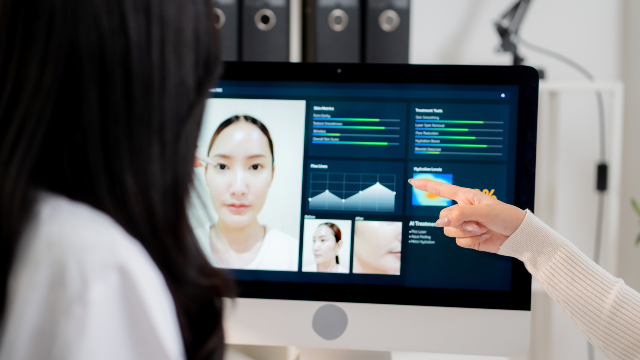
A digital skin scan before treatment looks, from the patient's side, like a minute in front of a camera. What it produces is not a photograph. It is a set of readings about conditions that sit at or below the surface — how your pores are behaving, how active your oil glands are, whether inflammation is present, and how deep your pigment actually lies. This article explains what each of those readings is, and why a reading can change what a plan is able to promise you.
A look is an impression; a reading is a record
Skin is unusual among organs in that it is fully visible, and that visibility is misleading. It makes people assume that looking is the same as examining.
Clinicians do not treat it that way. The National Library of Medicine's Bookshelf hosts Clinical Methods, a standard reference on physical examination, and its chapter on office techniques in dermatology makes the point plainly: many skin conditions can be recognized on sight, but simple in-office procedures confirm that first impression, and experienced dermatologists routinely run one anyway. The reason is that visually similar problems are common. Two marks that look alike to the eye can have different causes, sit at different depths, and respond to completely different treatment.
The same reference describes how little it takes to separate them. Diascopy — pressing a clear glass or plastic disc against the skin and watching what happens — tells you whether redness is blood still inside vessels, which blanches under pressure, or blood that has leaked into the surrounding tissue, which does not. One second of pressure answers a question that staring cannot.
A digital skin scan is the industrial version of that instinct. It is not a second opinion about how your skin looks. It is a set of measurements about how your skin is currently working.
What does a skin analysis machine measure?
At Plan Me Clinic the diagnostic scan uses multi-light facial imaging, and the fields it assesses recur across the clinic's treatment pathways. Here is what each one is actually reading, and what it tells you about yourself.
Pore condition
Pore size and pore condition are assessed directly. A pore is the opening of a follicle, and its appearance is a summary of several things at once: how much is being produced below it, whether the opening is obstructed, and how much structural support the surrounding skin still has. The clinic assesses pore size and condition as part of both its acne pathway and its pore and texture pathway.
Sebum activity
This is the reading most likely to surprise people, because it contradicts a very stubborn folk theory. StatPearls, the peer-reviewed clinical reference on the same NIH Bookshelf, describes the sebaceous gland as the source of about ninety percent of the skin's surface lipids, sitting in the mid-dermis and nearly always paired with a hair follicle — the two together are called the pilosebaceous unit. Sebum is not dirt. It lubricates the skin and forms part of its physical defense, and the production cycle inside the gland takes roughly a week from synthesis to release.
MedlinePlus, the National Library of Medicine's patient service, states the corollary bluntly: blackheads and pimples are not caused by dirty skin, and the idea that they are is a myth. A sebum activity reading replaces that myth with a number. It is measuring gland behavior, not hygiene.
Inflammation
Inflammation is assessed as its own field rather than being inferred from redness. That distinction matters because inflammation is what governs sequencing. Skin that is currently inflamed is not in the same state as skin that is merely marked, and a plan that ignores the difference is planning for a face that is not in the room.
Pigmentation type and depth
This is the field that changes plans most often. Plan Me Clinic's pigmentation pathway describes a scan that identifies pigmentation type and depth, together with any associated vascular or textural concerns.
Depth is not a detail. It is the single variable that most determines how long a pigmentation plan will take and how much improvement is reasonable to expect, and it is precisely the variable the naked eye is worst at judging. Two patches of the same apparent color can be sitting at different levels in the skin and behave quite differently.
Light is what makes depth readable. StatPearls describes Wood's light — a long-wave ultraviolet lamp used in a darkened room — as a long-standing method for detecting disorders of skin pigment, including melasma and vitiligo, and notes that the lamp changes how affected skin appears rather than treating it. It also records a detail that explains the whole principle: under that light, healthy skin reads blue, thickened areas can appear white, oily areas yellow, and dry or dehydrated areas purple. Different wavelengths make different properties of the skin visible. Multi-light imaging applies the same idea systematically.
Scar characteristics and surface texture
The scan assesses scar depth and characteristics alongside overall skin condition. Texture is difficult to assess honestly in a mirror, partly because bathroom lighting flatters and partly because you have been looking at your own face for decades and have stopped seeing it.
The name on the report
Plan Me Clinic performs its pre-treatment skin assessment with a system it calls JANUS. That is the answer most people are looking for when they search for JANUS skin analysis explained: it is the name of the clinic's skin diagnostic setup, not a treatment and not a product applied to you. The assessment is a reading step that happens before anything else, and the fields it records are the ones described above.
Everything that follows the reading is human. Dr. Seung-hwan Lee personally reviews the diagnostic results together with the patient's history before making a recommendation, and the clinic's stated position is that this review is part of the physician's work rather than an output that arrives on its own.
What a reading changes for you
The practical value of a scan is not that it produces a chart. It is that four specific things stop being guesses.
The realistic timeline. Improvement that develops progressively over a series of sessions, which is how Plan Me Clinic describes pore and scar work, is a different proposition from improvement you would see quickly. A depth reading is what tells you which of those you are in for before you commit to anything.
The order of operations. If inflammation is present, it generally has to be part of the conversation before texture work is sensible. A reading that makes inflammation explicit forces that sequence to be discussed rather than assumed.
The likelihood of recurrence. Sebum activity is not a snapshot of one bad week. It is a description of how your glands run, which is why the clinic's acne approach is framed around reducing recurrence rather than clearing one episode.
What you are actually treating. Dark circles are the clearest example anywhere in aesthetic medicine. Shadow caused by hollowing and darkness caused by pigment look similar in a mirror and are different problems. Plan Me Clinic's under-eye assessment begins by working out whether hollowing is the primary cause before any plan is designed, and that answer comes from looking properly rather than from the patient's description.
Immediate results change the conversation
One structural feature of the scan is easy to overlook: the clinic states that results are available immediately.
That matters more than it sounds. It means the findings and the discussion happen in the same appointment, so you can ask about what was found while the person who found it is still in front of you. A test whose results arrive next week produces a follow-up phone call. A test whose results arrive in the room produces a conversation, and a conversation is where questions get asked.
It also gives you something concrete to ask about. "What did the scan show about the depth of this?" is a better question than "will this work", because it has an answer.
What a scan cannot do
Three honest limits.
A scan does not replace history. The guide In brief: What happens during a skin examination?, published on the NIH Bookshelf by IQWiG's InformedHealth.org, describes the sequence correctly: the questions come first. When did you first notice this, did it appear suddenly or slowly, what might have triggered it, what medications and existing conditions are in play. Plan Me Clinic runs the same order — a personal consultation, then the scan. Its intake asks what you take and what you react to, whether cold sores are part of your history, whether your skin scars readily, and how much sun it has had recently. None of that is visible to a camera.
A scan does not interpret itself. The same StatPearls entry on Wood's light notes that although the examination can be performed by any trained healthcare worker, interpreting the findings is best done by a dermatologist or another experienced clinician. A reading is an input to a judgment, not a substitute for one.
A scan is a snapshot, not a forecast. The InformedHealth guide observes that skin can look atypical for a condition when it has been scratched or is inflamed, which makes any single assessment harder to read. It also notes that photographs make changes easier to track over time — which is the argument for the follow-up visits Plan Me Clinic uses to reassess progress, rather than treating the first reading as final.
How to make the reading worth having
Two small things improve what you get out of it.
Bring the history the scan cannot see. Recent sun exposure or tanning, current medications and supplements, allergies, previous cosmetic treatments, and any tendency to scar all change the interpretation of the same image. Leaving one out to keep things simple removes information the clinician needs.
Arrive with a concern rather than a product name. A scan can tell you what your skin is doing; it cannot tell anyone what bothers you about it. If you would like to read about the practice before you write, the clinic's about the clinic page is the place, and its contact page is the route to arrange an assessment.
The Bottom Line
- A diagnostic skin scan is a set of readings, not a photograph: pore condition, sebum activity, inflammation, pigmentation type and depth, and scar characteristics.
- Depth is the reading that changes plans most, because it is what sets a realistic timeline and is the hardest thing to judge by eye.
- Sebum activity measures how your glands behave, not how clean your skin is — MedlinePlus is explicit that dirt does not cause blackheads or pimples.
- Multi-light imaging works on a long-established principle: different wavelengths make different properties of skin visible, as StatPearls describes for Wood's light.
- The reading is an input, not a verdict. History, interpretation by a clinician, and follow-up reassessment all sit around it.
Frequently Asked Questions
What is JANUS skin analysis?
JANUS is the name Plan Me Clinic gives to the skin diagnostic setup used for its pre-treatment assessment. In practical terms it is the step where your skin is imaged and recorded before any plan is discussed, covering fields such as pore condition, sebum activity, inflammation and pigmentation.
Does a skin scan hurt, and is it safe?
It is a reading step rather than a treatment. StatPearls notes of Wood's light, one of the long-established methods of this kind, that the examination is brief, does not damage the skin or cause sunburn, and is unlikely to cause harm even in light-sensitive people, with the recommendation that patients keep their eyes closed during exposure.
How long do I wait for the results?
Plan Me Clinic states that results from its diagnostic scan are available immediately, which means the findings and the discussion of what they mean happen in the same visit rather than across two appointments.
Why does pigmentation depth matter so much?
Because it governs what is realistic. Pigment sitting at different levels in the skin behaves differently and responds over different timeframes, and it is very hard to judge depth by eye. Plan Me Clinic's pigmentation assessment identifies type and depth along with any associated vascular or textural concerns.
Can a scan tell me why I am breaking out?
It can describe the conditions involved — sebum activity, pore condition and inflammation — which is more useful than it sounds. MedlinePlus notes that no one knows exactly what causes acne, that hormonal change probably plays a role, and that common explanations such as dirty skin are myths.
Do I still need to tell the clinic my history if the scan sees everything?
Yes, and the history often matters more. The InformedHealth.org guide to skin examinations describes the questions as coming first: when a change appeared, how quickly, and what medications or medical conditions might be involved. Plan Me Clinic also asks about allergies, cold sores, scarring tendency and recent sun exposure.
Will I be scanned again later?
Follow-up visits at the clinic are used to reassess progress and treatment response. That is the appropriate way to treat any single reading — as a starting point that gets compared against a later one, rather than a permanent description of your skin.
This article is for general informational purposes and does not constitute individualized medical advice. It is not a self-diagnosis tool. Treatment suitability, session planning and aftercare must be determined by a qualified dermatologist or physician after an individual assessment, and any symptom that concerns you should be discussed with a clinician rather than researched alone.
More Articles
Continue reading our clinical guides.